Designing your Journey
Estimated Reading Time: 4-6 Minutes
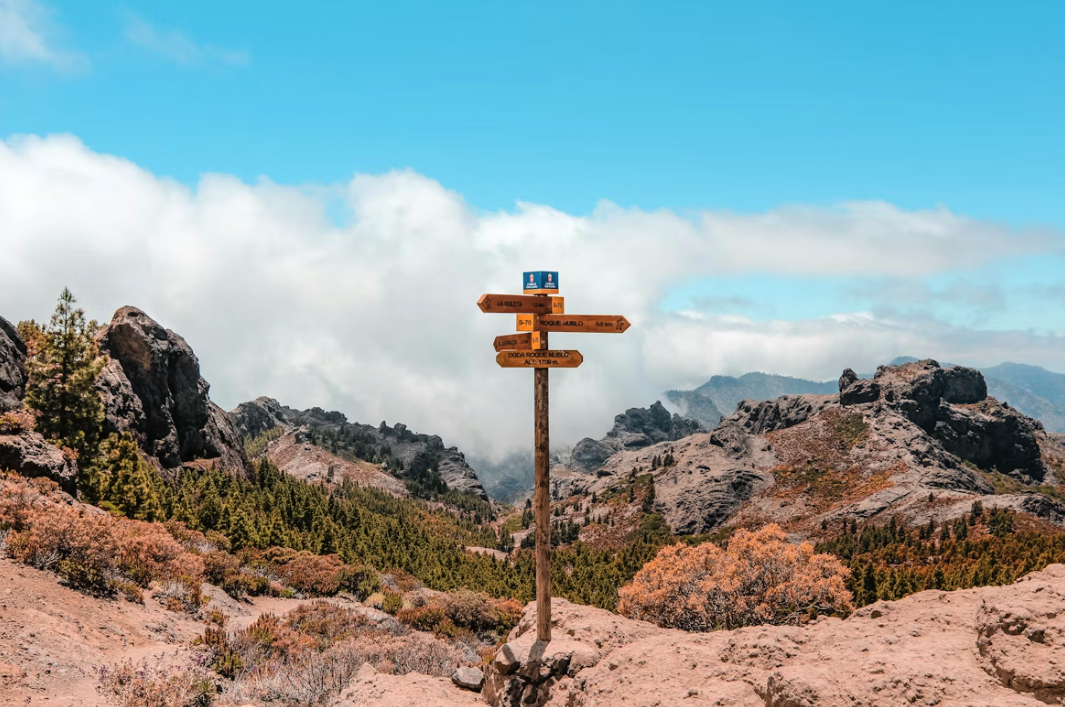
What are the crossroads you are currently at in your life right now?
Isaiah: This crossroads question is a question I often ask when working with teams. I introduce this question as a warm-up to get people conversing with one another, but the reaction I receive is always one of surprise. The typical response from the teams that I work with is a resounding deep breath or a comment "whoa, this is deep." My assumption of why a question like this catches people by surprise or feels "deep" is because they can't rely solely on their cognition. They can’t use logic, make a list or weigh all the options. They have to feel and listen to their body because the body often knows things the mind hasn't caught up to yet. This question requires us to be still and think in a different way. A stillness that surfaces what the noise buries. This isn't soft thinking. It's a different kind of rigor. A rigor that a lot of us never make enough space or time for.
There's a question I've been sitting with lately, one that I suspect I'm not alone in carrying: is there a difference between certainty and direction? Because I think we've conflated the two. The crossroads most of us are standing at right now isn't really a question of what's next. It's a question of whether we trust ourselves enough to find out.
Crystal: I’m currently in a yoga teacher training program and it’s really challenging. I joined this as a way to deepen my understanding of my physical body and yoga practice and it has opened up new questions. Isaiah noted that stillness surfaces what noise buries. The work I find most challenging is sitting still. Movement has always been easier for me so stillness is the challenge and opens up new questions about how I want to be in the world.
And yet, as I challenge myself to do something new and out of my comfort zone, I discover I am breaking my own stereotypes of who I am and how I might show up differently in the world. It makes me think this is a new crossroads of how I want to be instead of what I want “to do.”
Shu Shu: This conversation also makes me think of that perennial bumper sticker: “All who wander are not lost”! Three years ago, I surprised family and friends by enrolling in a Masters in Social Justice at Union Theological Seminary, a divinity school in NYC. As I head toward graduation in May, so many people have asked me, What’s next? We have been socialized to see our life as a linear path, a series of “what’s nexts.” What if, instead, our life was a spiral and we circled around our ultimate purpose, gathering experiences and wisdom along the way? What if my time at divinity school gave my little potted plant a bigger home, more fertilizer, a wider patch of sun?
Then the question shifts subtly from “What’s next” to a deeper exploration of who I am now and who I am becoming. What do I want to learn from my new perspective, my wandering?
How might we think about transitions with a new lens?
Crystal: I am moving more and more to thinking about change and transitions as an on-going practice rather than a project with a specific outcome. As a former Head of School, I have previously spent a lot of time in my head “working” –i.e. solving problems, coming up with concrete plans, and responding to others’ needs. That was the job.
And, now as someone who is working alongside school leaders, listening, observing and supporting their journeys, I often wonder how we might open up different ways of knowing and being in our world.
The concepts shared by Dave Evans and Bill Burnett in their book, Designing Your Liferesonate as they talk about reframing our questions and our approaches. Instead of searching for the answer or needing more information to make a decision, they suggest we employ “discernment” as a tool. “Remember, the default response to being stuck on a decision: I must need more information!” What we cannot see is exactly what we do not need. It’s our too-noisy brain, talking at us constantly as they try to cogitate our way to a good decision…”
There are other ways of knowing in the world beyond thinking, logic and reason. What if we utilized more ways of knowing as we reframe our journeys? How might meditation, journaling, art, faith, memory and imagination be tools for design when we are at a crossroads?
I find the work of Robin Wall Kimmerer helpful as I think about learning about different “ways of knowing.” She suggests that we look to ourselves and the natural world to find purpose and meaning. She starts Braided Sweetgrass with the story of Skywoman whose people brought to the land the "Original Instructions” to “use your gifts and dreams for good.” The Original Instructions are not prescriptive but serve as a compass for a way of working and living. Kimmerer says, “The work of living is creating that map for yourself.” Kimmerer reminds us that “we too are always falling….spinning into someplace new and unexpected.” In other words, perhaps we need to trust our intuition and heart as much as our head when thinking about our journeys.
Isaiah: In many ways, this conversation reminds me of what humanistic psychologists like Carl Rogers believe to be true about growth. Rogers argued that people do not grow primarily through instruction but through conditions that allow something already present within them to emerge. The work is less about engineering outcomes and more about cultivating the environment in which truth can surface.
In other words, if change and transition is treated as a problem to solve, then naturally we reach for more information, better frameworks, sharper analysis. But if change is actually a transition of being or becoming, then maybe something different may be required.
This is where the feeling of “discernment” becomes interesting to me. Discernment, especially in uncertain times, suggests that the answer is not something we manufacture through cognition but something we learn to notice. It requires a quieter interior life and it asks different capacities of us. Maybe what we need is not better thinking but deeper presence. And we hope DesignYour Journey can offer just that.
What is “Design Your Journey” and why might this program be for you?
Design Your Journey is built to give you the time and space to form that compass for your life, professional or personal. For three days in magical Santa Fe, New Mexico, you’ll join a small, intimate cohort of people who are tapping into their hearts and intuition, their minds and experiences to envision this moment in new and generative ways. Through a combination of provocative activities using human-centered design, as well as generous spaces for longer conversations, time with art and nature, and healing silence and stillness, you will have the opportunity to reflect on where you’ve been, make sense of where you are, and plan for what’s next. We will be right there with you, doing the same important work for ourselves.
This retreat is a beginning of a process, not a stand alone event. Quarterly virtual meetings, a buddy pairing, and a 1:1 coaching session in winter 2027 will keep your thinking alive throughout the 2026-2027 school year.
Who is this retreat designed for:
Leaders who sense that something in their work or life is shifting, and want time for reflection or creative inspiration to navigate that thoughtfully and with intention.
Leaders wondering what “what’s next?” looks like, whether it's within or beyond their current role.
Those drawn to human-centered design as a framework for reimagining their role, their stage of life, or their work in schools.
Anyone in the middle of a significant change (new role, new chapter) who is ready to approach it with intention rather than just momentum.
Leaders who want to “end well” or transition smoothly and gracefully, whether from a position, a school, or a new phase of life.
For schools and school leaders investing in retention by giving their people the rare gift of space for career and personal reflection.
This program is scheduled for the end of October, a time of bright autumn sun and cool breezes in Santa Fe. It’s also just when you might think you don’t have time to invest in yourself. This program is a gift for you but it is also a commitment to being the leader and person your community needs you to be. We look forward to sharing your journey.
For more information on this program, please check out the link on our website: What’s Next: Design Your Journey.